North Carolina board members who are asked which law governs their community are likely to give several different answers. Some will name the Planned Community Act, some will say the state has no HOA law, and a few will point to the community's own governing documents. In AMG's experience, that range of answers is an understandable response to a legal structure that draws on several sources, including more than one statute.
This guide is intended for volunteer directors, community managers, and homeowners who need an overview of that structure. Each major topic is introduced here and addressed in greater detail on the linked companion pages.
Association Management Group (AMG) prepared this guide for general informational purposes. AMG is a community association management firm, not a law firm, and this guide does not constitute legal advice. Statutes, and the court decisions interpreting them, change over time. Legal questions, and the final interpretation of any statute or of the governing documents, should be confirmed with qualified legal counsel.
In this guide, the term governing documents refers collectively to the association's plat, articles of incorporation, bylaws, declaration, rules and regulations, and all policies adopted by the board or the membership.
What Laws Govern North Carolina HOAs?
North Carolina associations are generally governed by a combination of sources rather than a single law. Those sources include state statutes, the association's governing documents, and applicable federal and local law.
Which state statute applies depends on the type of community and when it was created. A townhome neighborhood in Winston-Salem, a high-rise condominium in Charlotte, and a 1970s condominium near the coast may each operate under a different statutory framework. Although the frameworks overlap in places, the differences between them remain significant.
The General Statutes alone answer relatively few day-to-day questions. Most are resolved by the community's governing documents, read in light of the statutes and other law that apply. The general order of precedence runs from federal law, to state statutes, to municipal ordinances, to the recorded plat, to the declaration, to the articles of incorporation, to the bylaws, to rules and regulations, and finally to board decisions. A lower-ranking source generally cannot override a higher one.
Understanding the Governance Hierarchy
The chart below outlines the typical hierarchy of authority in many community associations. Precedence, interpretation, and enforcement may vary with the governing documents and applicable law. A more detailed description of each level follows.
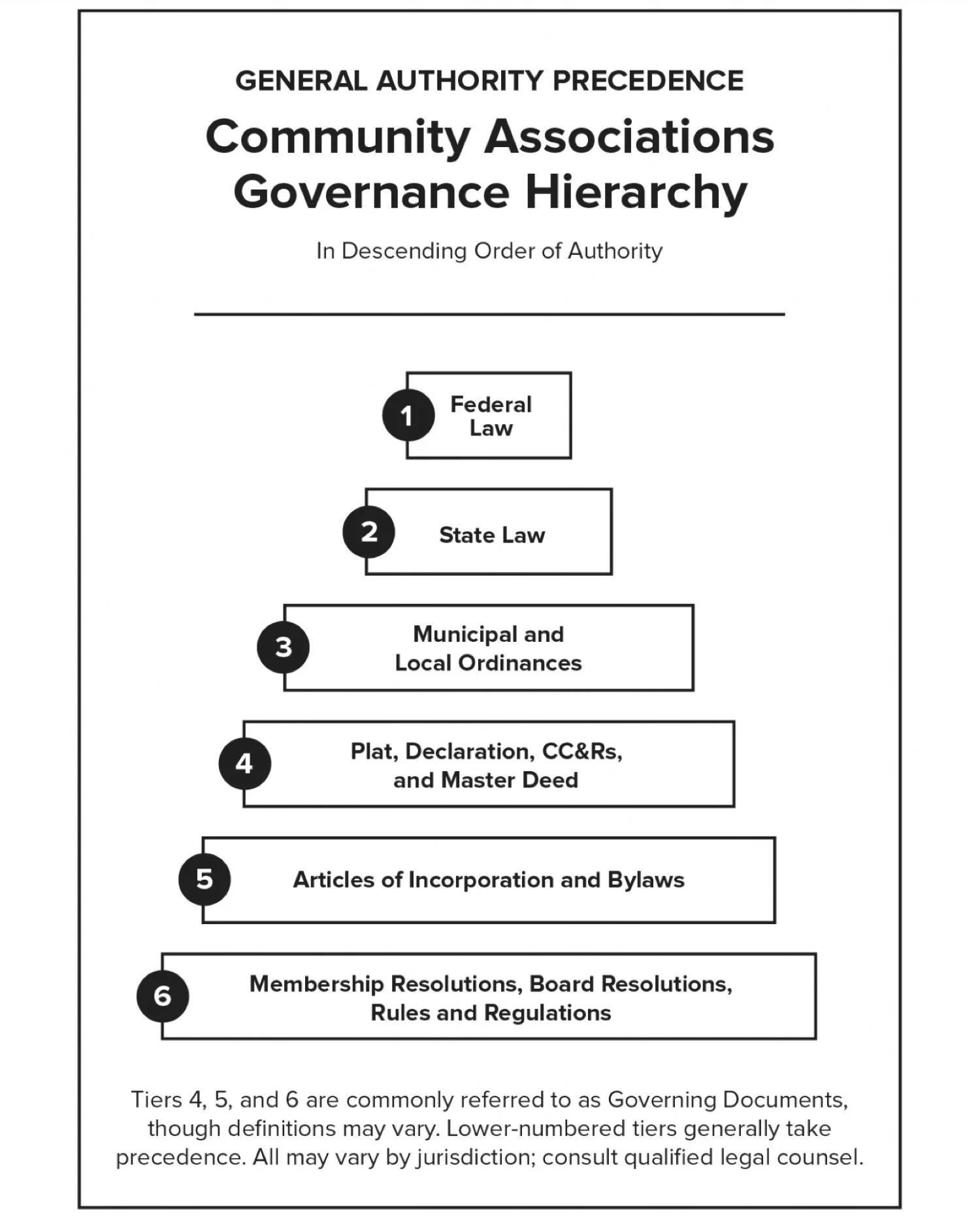
Chart adapted from the hierarchy described in the supplied article copy. Original source credits Lessons from the Neighborhood.
#1 Federal Law
Laws enacted by Congress that apply nationally. Federal law generally takes precedence over conflicting state or local law, and an association's governing documents are generally required to comply with applicable federal requirements.
#2 State Law / Statutes
State statutes that govern the formation and operation of community associations, condominiums, and nonprofit corporations. The scope, requirements, and protections of these statutes vary significantly from state to state, and not every state has comprehensive HOA or condominium legislation. North Carolina addresses the subject through more than one chapter of the General Statutes, as described below.
#3 Municipal / Local Ordinances
Laws and regulations enacted by cities, counties, and other local government bodies, which apply independently of the association. Local ordinances may affect association operations, land use, and property standards, and their interaction with the governing documents depends on the locality.
#4 Plat, Declaration of Covenants, Conditions, and Restrictions (CC&Rs) / Master Deed
The plat and the declaration are recorded in the county land records and typically establish the fundamental rights, responsibilities, and restrictions within a community. They commonly address property use, assessments, maintenance obligations, and architectural standards, and their content and enforceability vary from community to community.
#5 Articles of Incorporation and Bylaws
The articles of incorporation and the bylaws typically establish the association as a legal entity and set out its internal operating rules. They commonly address board structure, officer roles, voting procedures, and meeting requirements, and their legal effect may depend on applicable corporate and nonprofit law.
#6 Membership Resolutions, Board Resolutions, Rules and Regulations
Policies, procedures, and formal decisions adopted by the membership or the board to manage day-to-day community operations. They are generally expected to be consistent with the higher-ranking governing documents and applicable law, which also define the extent of the association's authority to adopt them.
This chart is a simplified representation for illustration purposes. Higher-level authorities generally take precedence in any conflict. Tiers 4, 5, and 6 together correspond to the governing documents as defined in this guide.
Four Chapters of the General Statutes Form the Statutory Framework
North Carolina does not have a single HOA statute. Boards generally work with a community statute and, if the association is incorporated, a corporate statute at the same time. The community statute is usually one of three: the Planned Community Act, the Condominium Act, or the Unit Ownership Act. The corporate statute is the Nonprofit Corporation Act, which applies alongside, and supplements, whichever community statute governs.
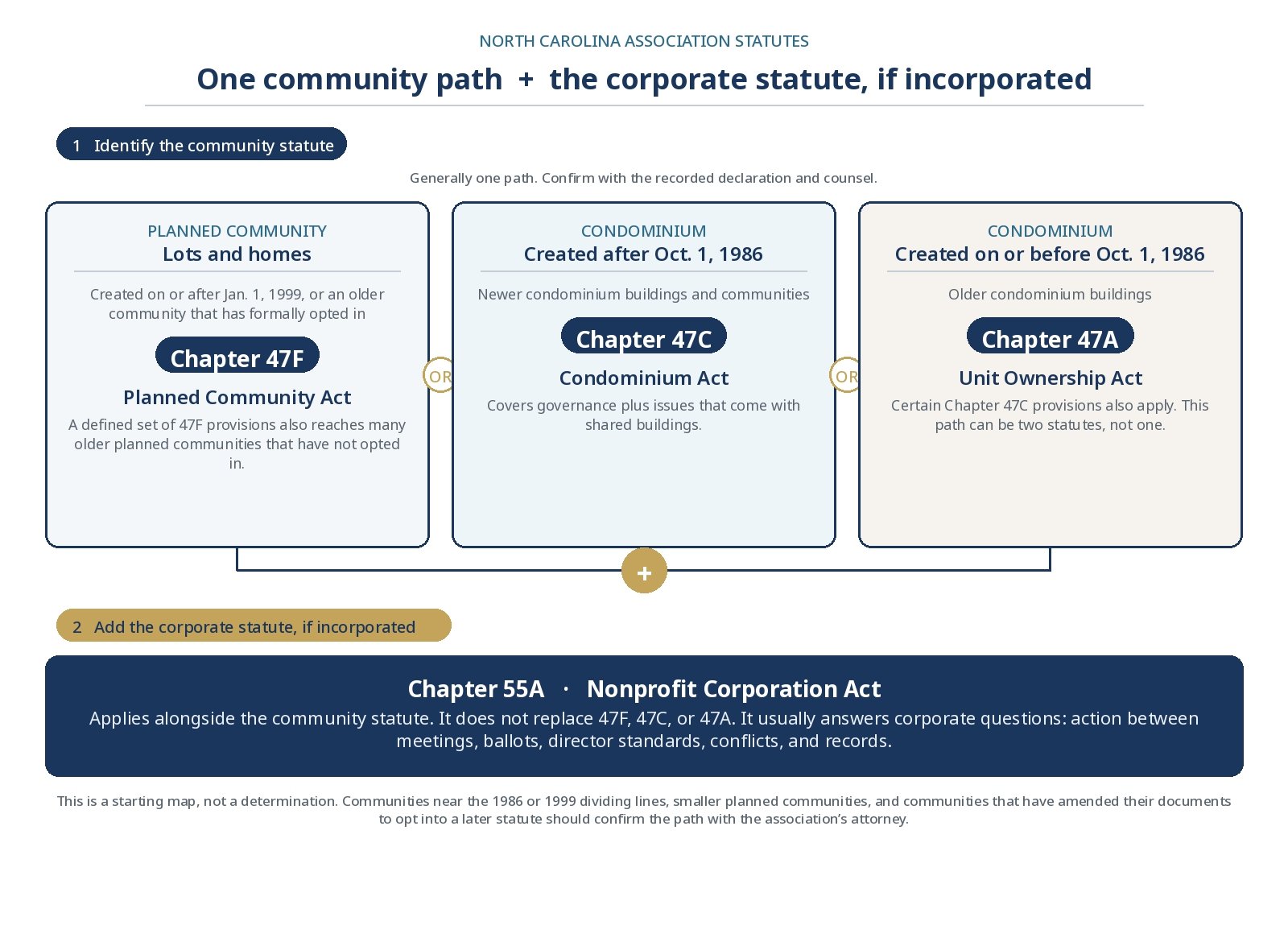
Which community statute applies generally depends on the type of community, the date on which its declaration was recorded, and, for an older planned community, whether it has formally elected coverage under the Planned Community Act. For a condominium created close to October 1, 1986, or a planned community created close to January 1, 1999, the exact creation date can determine which statute applies, or how much of it applies.
Not every planned community is governed by the full Act. A planned community created on or after January 1, 1999, with no more than 20 lots, or with all lots restricted exclusively to nonresidential purposes, is outside Chapter 47F unless its declaration provides, or is amended to provide, that the Act applies. A planned community created before January 1, 1999, is subject only to a listed set of Chapter 47F provisions unless it has elected coverage under the full Act.
AMG has managed communities across the Carolinas for more than 40 years. In that time, AMG has observed that boards that confirm early which statutes govern their community spend less time later debating what the law requires and more time working from their own governing documents.
This page is the pillar for AMG's North Carolina HOA laws hub. Companion pages address the Planned Community Act, the Condominium Act, the Unit Ownership Act, the Nonprofit Corporation Act, and federal and municipal law.
NC Planned Community Act
For communities made up of individually owned lots and homes, Chapter 47F, the Planned Community Act, is the statute most boards know. It applies in full to planned communities created on or after January 1, 1999, other than certain small and nonresidential communities. A listed set of its provisions also applies to planned communities created before that date, unless the community's articles of incorporation or declaration expressly provide otherwise; those provisions reach only events on or after January 1, 1999, and do not invalidate existing provisions of the declaration, bylaws, or plats.
An older planned community may elect coverage under the Act as a whole by amending its declaration with the approval of owners holding at least 67 percent of the votes in the association, or any smaller majority the declaration specifies, and that statutory procedure controls over any conflicting amendment requirement in the declaration. The election cannot be accomplished by a board motion or by following the declaration alone as a matter of practice.
Chapter 47F addresses association powers, board authority, assessments and collection tools, meetings, rule adoption, and certain owner protections, and it operates together with the governing documents. In many areas it supplies a default rule that may be varied to the extent the Act expressly permits; in others, its requirements cannot be varied. Distinguishing between the two is a legal determination.
A board's first step is therefore to determine whether Chapter 47F applies to the community, in whole or in part, and how the governing documents address the same point.
NC Condominium Act
For a condominium created after October 1, 1986, Chapter 47C is generally the starting point. It covers many of the same governance subjects as the Planned Community Act, together with issues specific to shared buildings: insurance across common structures, the division between unit and common-element maintenance, and purchaser-protection rules that do not appear in Chapter 47F.
Condominiums created on or before that date operate under a different framework, described in the Unit Ownership Act section below.
NC Unit Ownership Act
For a condominium created on or before October 1, 1986, Chapter 47A, the Unit Ownership Act, is generally the foundation. Enacted in 1963 as North Carolina's original condominium statute, it remains relevant for buildings created from the 1960s through October 1, 1986. The governing documents of those communities were often drafted for a different era of community living, and their actual text may differ from what owners and directors recall.
Chapter 47A is only part of the picture. A defined set of Chapter 47C provisions also applies to these older buildings, notwithstanding any conflicting provisions in their articles of incorporation, declaration, or bylaws, with respect to events and circumstances occurring after October 1, 1986. These provisions cover subjects such as association powers, board members, fines and suspension procedures, meetings, assessments, liens and records, so the community may be working with two statutes as well as governing documents.
Chapter 47C does not provide a procedure for an older condominium to elect coverage under the newer Act as a whole. Under §47C-1-102(b), however, Chapter 47A does not invalidate an amendment adopted by an older condominium if Chapter 47C would permit the amendment, provided the amendment is adopted under the condominium's own amendment procedures and Chapter 47A. If the amendment grants a right or power permitted by Chapter 47C, the corresponding Chapter 47C obligations and restrictions apply as well.
For such a community, the first step is to determine which parts of each statute apply to the building and how the governing documents address the same point. That overlap can be mapped by the association's attorney and kept on file as a reference the board can reuse.
NC Nonprofit Corporation Act
Most North Carolina associations are nonprofit corporations, so Chapter 55A usually applies alongside the Planned Community Act or the applicable condominium statute. It tends to answer procedural questions those chapters leave open: how a board acts between meetings, how a vote by ballot is conducted, what standards of conduct apply to directors, how conflicts of interest are handled, and how certain records requests are treated.
Where a community-specific statute and the Nonprofit Corporation Act both address the same point, the community-specific statute typically controls. The analysis becomes more difficult when the two texts are similar but not identical. Such conflicts present legal questions and arise most often in connection with elections, written consents, director removal, and inspection of records.
Where Chapter 55A applies, the more practical question is whether a particular issue is governed by the community statute, the corporate statute, the governing documents, or some combination of the three. Keeping corporate filings and records current, including registered agent information, the articles of incorporation, minutes, and, beginning in 2027, the new annual report to the Secretary of State (first due November 15, 2027), also helps prevent problems that arise from the association's status as a corporation rather than from its role as a community association.
HOA Meeting Rules
Meetings are where an association exercises its authority, and they are often where procedural problems begin. Recurring questions include how much notice members receive, what a board may discuss outside an open session, how minutes should be kept, whether virtual or hybrid participation is permitted, and how owner comment can be accommodated within a reasonable meeting length.
Annual meetings, board meetings, and special meetings are distinct events, and different notice, quorum, and purpose requirements can attach to each. Those requirements usually derive from the governing documents and the applicable statute together. Where the two overlap, a prudent practice is to satisfy the stricter requirement and to keep a record of what notice was sent, to whom, and when.
Executive session is appropriate for confidential matters, and its use for ordinary business can erode owner trust. Minutes should record the actions the body took rather than every comment made during the meeting.
Virtual and hybrid meetings can broaden participation. Whether a particular community may use them, and how notice, quorum, and voting must be handled if it does, depends on the governing documents and applicable law. Governing documents adopted before the technology existed may not address the subject.
HOA Voting & Election Rules
Election season produces more procedural questions than almost any other point in the year: who may vote, how delinquent accounts are treated, whether a proxy is valid, whether electronic ballots are permitted, and what happens when a quorum is not reached. In many communities, failure to reach quorum is the most common annual-meeting problem.
The answers usually come from three sources at once: the community statute, the Nonprofit Corporation Act, and the governing documents. For planned communities created before January 1, 1999, that have not elected coverage under the full Act, and for condominiums created on or before October 1, 1986, the quorum and voting-and-proxy provisions of the community statute do not apply; the declaration and bylaws, together with Chapter 55A for an incorporated association, generally supply those rules. Eligibility, proxies, ballots, quorum, director removal, and election challenges all fall within that overlap. A long-standing practice can still be defective if the governing documents required a different procedure.
Boards that document their election procedure once, have it reviewed by counsel, and apply it consistently each year tend to experience fewer disputes than boards that reconstruct the process at each election.
HOA Liens & Foreclosure
Assessments fund the community's obligations, and an association that does not collect consistently shifts that cost onto the owners who pay. Because collection involves owners' homes, the required steps are strict and are not suited to improvisation by the board.
North Carolina law provides associations with a lien and enforcement process for unpaid assessments. Foreclosure is part of that framework in defined circumstances and is not a routine collection tool. The recording, notice, timing, and enforcement steps are detailed, and associations typically involve their attorney before a claim of lien is filed or other legal collection action begins. In AMG-managed communities, AMG provides administrative support for billing and recording assessments, assists in preparing account statements and ledgers, and, when the board refers an account to the association's attorney, helps compile the account information counsel needs. Decisions about pursuing delinquent amounts rest with the board and its attorney.
A written collection policy, reviewed by counsel and applied uniformly to every account, helps protect owners from inconsistent treatment and helps protect directors from claims that one owner was treated differently from another. Payment plans, where the association offers them, tend to work best when their terms are standard, written, and short enough that the balance steadily declines.
HOA Dispute Resolution
Most serious disputes in community associations do not begin as lawsuits. They typically begin with a letter that was received more harshly than intended, a request denied without explanation, or a rule enforced in one part of the community but not another.
North Carolina provides a voluntary statutory mediation pathway for many disputes between associations and owners under § 7A-38.3F, although disputes concerning only unpaid assessments and related fines or fees are excluded. Direct discussion between the parties still resolves more matters than any formal process, and mediation is often the next step when discussion does not succeed. Arbitration applies only if the declaration, bylaws, or another written agreement between the parties provides for it. Litigation is slow, public, and expensive, and it can strain a neighborhood whose residents continue to live together afterward.
The association's attorney represents the association itself rather than any individual owner or director.
Unenforceable HOA Rules
A rule can fail for several reasons, of which a statutory prohibition is only one. Some rules exceed the authority granted by the governing documents, and some were never adopted through the required process. Others conflict with statutory or federal protections, including those addressing flags, certain political signs, solar equipment, antennas, and fair housing. How a rule was adopted, and how it has been applied since, can affect its enforceability.
Boards and owners can each hold reasonable positions on these questions. Communities adopt standards because shared property requires them, and owners have a legitimate interest in how far those standards reach and whether they are applied uniformly.
This page is written for both boards and owners. An owner who believes a rule was not properly adopted, or has been applied unevenly, may raise the concern with the association. The effect of past non-enforcement on whether a rule may be enforced today is a fact-specific legal question, and neither owners nor boards should assume that a period of non-enforcement resolves it.
Many boards find it useful to maintain a simple inventory of every rule the association applies, the source of authority for each, when and how each was adopted, and how each has been applied. At the board's direction, AMG can help compile the available adoption records and enforcement correspondence for review by the board and the association's attorney. An inconsistent enforcement history is useful to identify before the next notice is issued, and its legal significance depends on the facts.
Federal and Municipal Law
State statutes and governing documents do not make up the whole picture. Federal fair housing law reaches community associations, and federal communications rules affect certain antennas and satellite equipment. Municipal ordinances, zoning, and permitting requirements can apply alongside association standards, so an owner may need both a city or county permit and association approval for the same project.
Federal and municipal requirements operate alongside the governing documents, either above them or beside them, depending on the issue. A rule that is valid under the governing documents can still conflict with a federal protection. A project that is prepared to approve may still require a municipal permit, and neither approval substitutes for the other.
Which ordinance applies depends on the city or county with jurisdiction over the property, and the answer differs among Charlotte, Greensboro, Raleigh, and coastal towns.
When to Involve Legal Counsel
Whether to involve counsel is a judgment for the board, informed by the governing documents and the circumstances. Matters that commonly warrant the involvement of the association's attorney include, but are not limited to, the following:
- Uncertainty about which statutes govern the community
- Amending the governing documents
- Enforcement involving a fine or suspension of privileges
- A lien or collection matter, before it begins
- Fair housing, reasonable accommodation, or assistance animals
- Developer transition
- A point where a statute and the governing documents appear to conflict
- Periodic review of policies, procedures, and enforcement practices
- Any matter the board is unsure about, even if it is not on this list
Because most substantive questions involve state statutes, federal law, municipal ordinances, and the governing documents at once, weighing which authority controls is the work of counsel. At the board's direction, AMG can help coordinate communications with the association's attorney and assist in gathering the information counsel requests.
Frequently Asked Questions
What laws govern HOAs in North Carolina?
North Carolina community associations are generally governed by state statutes, the association's governing documents, and applicable federal and local law. The applicable state statute depends on the community type and creation date; it is most often the Planned Community Act for planned communities or the Condominium Act for newer condominiums. Because most associations are incorporated, the Nonprofit Corporation Act generally applies alongside whichever community statute governs.
Which North Carolina statute applies to an HOA?
The type of community and the date its declaration was recorded generally determine which statute applies. Planned communities of individually owned lots and homes created on or after January 1, 1999, fall under Chapter 47F in full, except those with no more than 20 lots or only nonresidential lots whose declarations do not adopt the Act. Planned communities created before that date are subject to a listed set of Chapter 47F provisions, unless their articles of incorporation or declaration expressly provide otherwise; these provisions reach only events on or after January 1, 1999, and do not invalidate existing provisions of the declaration, bylaws, or plats. An older planned community may elect coverage under the full Act by amending its declaration. Condominiums created after October 1, 1986, fall under Chapter 47C. Condominiums created on or before that date fall primarily under Chapter 47A, with a listed set of Chapter 47C provisions applying, notwithstanding conflicting provisions in their documents, to events after October 1, 1986. Chapter 47C provides no election for older condominiums to adopt the full Act.
Can an HOA foreclose on a home in North Carolina?
North Carolina law provides associations with a lien and enforcement process for unpaid assessments, and foreclosure is part of that framework in defined circumstances. The requirements are detailed and the consequences are serious.
Are HOA board meetings open to homeowners in North Carolina?
The Planned Community Act and the Condominium Act generally require the board, at regular intervals, to provide owners an opportunity to attend a portion of a board meeting and to speak, subject to reasonable limits on the number of speakers and the time allowed (§ 47F-3-108(b); § 47C-3-108(b)). That requirement does not make every board meeting, or every portion of a meeting, open to owners, and boards may still meet in executive session for confidential matters. The specific practice in a given community also depends on its governing documents.
What can an HOA not do in North Carolina?
Association authority is limited by the governing documents, the applicable statute, and other state and federal law. Statutory protections address matters such as the display of United States and North Carolina flags and certain political signs. As of August 11, 2026, S.L. 2026-59 removed the statutory language that had allowed a community's restrictions to opt out of the flag protection, so restrictions may no longer be construed to prohibit or regulate a United States or North Carolina flag no larger than four feet by six feet, displayed in accordance with or in a manner consistent with 4 U.S.C. §§ 5–10, on property owned exclusively by the owner. For a planned community created before January 1, 1999, § 47F-3-121 applies only through § 47F-1-102(c), which S.L. 2026-59 did not amend. That provision yields to an express contrary provision in the articles of incorporation or declaration and does not invalidate existing provisions of the declaration, bylaws, or plats and plans, so the effect of the 2026 change on such a community depends on those documents. Federal fair housing requirements affect rules that touch protected classes and reasonable accommodations.
How AMG Supports the Board
Many boards find it useful to keep a one-page summary of the association's legal structure, prepared with the association's attorney, that records which statutes govern and why, the date on which the community was created, whether the association is incorporated, and whether an older planned community has elected coverage under the Planned Community Act. Keeping that summary with the association's records, together with current copies of the governing documents and any responsibilities chart, collection policy, or election procedure the board has adopted, helps new directors understand the association's structure as boards turn over. AMG supports the board in this work by helping gather available documents, preparing draft policies and procedures for review by the board and counsel, and, at the board's direction, liaising with the association's attorney when a matter may require legal judgment.
A related practice concerns claims about what state law requires. When a discussion reaches the phrase “state law requires,” the board benefits from identifying the source of that statement. It may be a statute or a court decision, or it may be an assumption carried over from a previous board, a newsletter article, or an informal conversation. Identifying the source helps the board avoid decisions that must later be reversed.
Have Questions About Your Own Community?
Boards of AMG-managed communities are encouraged to begin with their community manager, who can help the board locate the relevant governing documents and other available information and, at the board's direction, liaise with the association's attorney when a legal question arises. Associations that are not currently AMG clients may contact AMG's client services team for information about AMG's management services or for referrals to qualified professionals.
AMG provides administrative management services to associations and is not a law firm. AMG acts on behalf of the associations it manages rather than individual owners, and an owner involved in a dispute with an association may wish to consult independent counsel.
About AMG
This guide was prepared by Association Management Group (AMG), an AMG-accredited community association management firm serving more than 30,000 property owners across the Carolinas. It draws on the work of AMG's professional managers and was reviewed by Paul Mengert, CMCA®, PCAM®, AMG's founder and CEO. The information is intended to assist community association members and leaders in understanding the statutory framework in which their associations operate.
Learn more at www.amgworld.com. Additional governance discussion appears in the Lessons from the Neighborhood series at www.LessonsFromTheNeighborhood.com .